
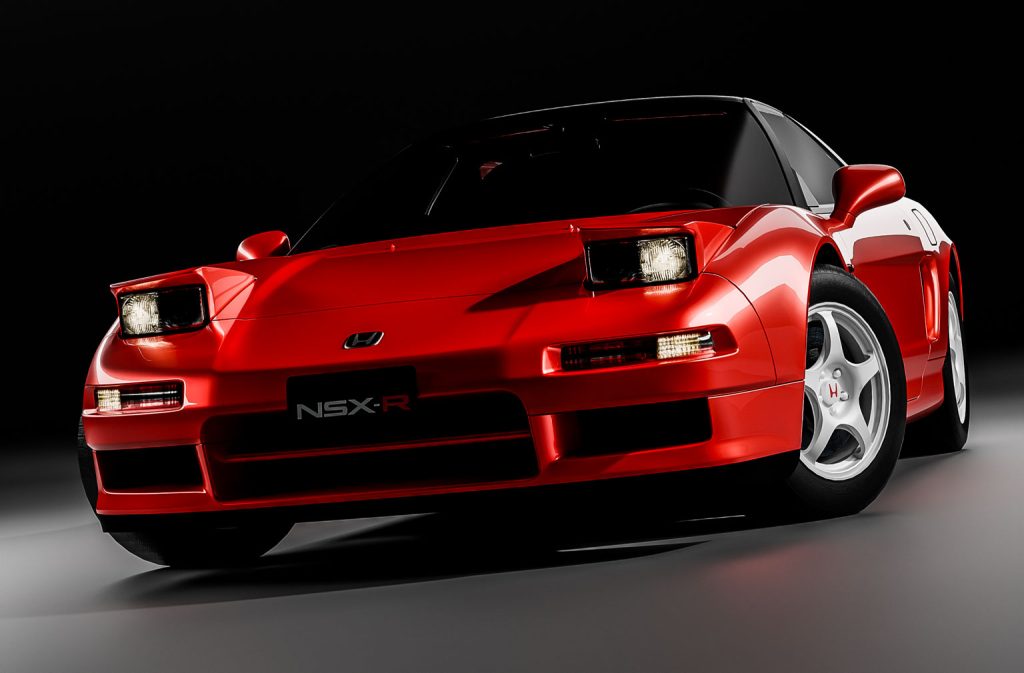
The 1992 Honda NSX is more than a sports car—it is a cultural and engineering milestone that redefined how the world perceived Japanese performance vehicles in the early 1990s. Designed with a philosophy rooted in precision, balance, and human-centered engineering, the NSX stood as a quiet rebellion against excess. This 3D modeling and rendering project focuses on reinterpreting that icon through a modern digital pipeline, while staying deeply loyal to the visual language of 1990s studio photography and automotive advertising.
The primary objective of this project was not to redesign the car, but to study, analyze, and faithfully recreate the lighting behavior, material response, and photographic atmosphere of early-90s automotive studio shoots. During that era, car photography relied heavily on controlled light shaping, restrained contrast, and subtle reflections rather than aggressive highlights or HDR-heavy visuals. This project aims to capture that restraint in a contemporary 3D environment using Blender 4.5 and the Cycles render engine.
The Honda NSX was an ideal subject for this study. Its clean surfacing, low beltline, and balanced proportions make it exceptionally sensitive to light direction and reflection flow. Unlike modern supercars that rely on extreme creases and visual aggression, the NSX communicates speed and performance through smooth transitions and purposeful geometry. That makes it unforgiving—and perfect—for a lighting-focused rendering study.
3D Modeling Approach
The 3D model was built with accuracy and realism as non-negotiable goals. Reference materials included original factory photos, archival press images from the early 1990s, and period-correct studio photography to ensure proportions, panel breaks, and surface continuity stayed authentic. Special attention was given to body curvature continuity, edge softness, and real-world tolerances—elements that directly affect how light travels across the surface in a physically based render.
Instead of exaggerating forms for visual impact, the modeling approach respected the NSX’s original industrial design intent. This restraint was intentional. The goal was to let lighting and material realism do the talking, not artificial geometry tricks.
Materials and Surface Realism
Materials were developed using a physically based workflow inside Blender’s Cycles engine. The paint shader was built to replicate period-correct automotive finishes—clean, deep, and refined, without modern hyper-metallic flake exaggeration. Clear coat depth, Fresnel response, and micro-roughness variation were carefully tuned to match how cars were photographed in the 1990s, when finishes appeared softer and more photographic than digital-perfect.
Rubber, glass, trim, and metal components were handled with equal discipline. Nothing was over-polished. Nothing was artificially aged. The result is a car that feels preserved, not stylized—a digital artifact that could plausibly exist in a Honda studio archive.


Lighting: The Core of the Study
Lighting was the heart of this project.
The setup was inspired by classic studio photography techniques used in automotive advertising during the late 80s and early 90s. Large, soft light sources were positioned to create smooth highlight gradients across the body panels, emphasizing form rather than texture. Hard specular highlights were avoided unless they served a compositional purpose.
Instead of dramatic rim lighting or modern cinematic contrast, the lighting strategy focused on:
Controlled reflections
Subtle shadow falloff
Balanced exposure across all surfaces
Clean separation between body, wheels, and background
This approach mirrors how professional photographers once shaped light manually using physical scrims, reflectors, and diffusion panels. Translating that analog mindset into a digital environment required careful iteration and restraint.
All renders were produced using Cycles with 450 samples, prioritizing clean light behavior and accurate global illumination without unnecessary noise. The result is a photographic look that feels intentional, calm, and timeless.
Color Correction and Final Touches
Post-processing was kept minimal and purposeful. Final color correction and tonal adjustments were done in Adobe Lightroom, following a photographic workflow rather than a compositing-heavy CGI approach. Adjustments focused on:
Color balance consistency
Contrast control
Highlight roll-off
Shadow clarity
No heavy effects were added. The goal was not to “fix” the render, but to finish it—just like a real studio photograph.
This final step helped reinforce the analog feeling of 90s automotive imagery, where post-production enhanced realism rather than overpowering it.
References


Why This Project Matters
In an era where 3D automotive renders often lean toward hyper-realism, excessive contrast, and dramatic cinematic lighting, this project intentionally takes the opposite path. It explores discipline, subtlety, and historical accuracy—qualities that are increasingly rare but incredibly valuable.
Studying past visual languages is essential for designers and visual artists who want to create meaningful work today. The 1990s represented a turning point in automotive design and photography, where technology and craftsmanship met without excess. This project serves as both a technical exercise and a visual homage to that era.
By combining modern tools like Blender 4.5 and Cycles with a historically informed artistic direction, this Honda NSX render demonstrates how digital workflows can preserve—not replace—classic design values.
This project stands as a personal study, a technical showcase, and a reminder that sometimes the most powerful visuals come from restraint, clarity, and respect for the original design.
